"sponsored links"

Powered by WebRing.
Google
 

Wednesday, April 30, 2008

Part 5: Sewing and increases / tools

supplies and tools

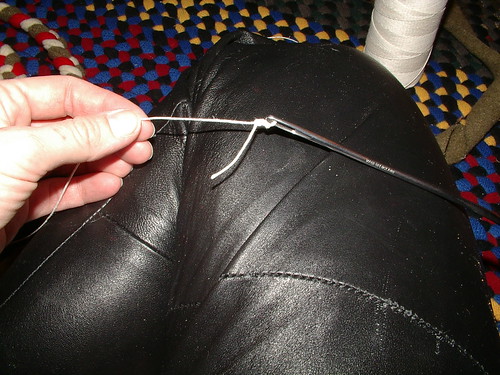
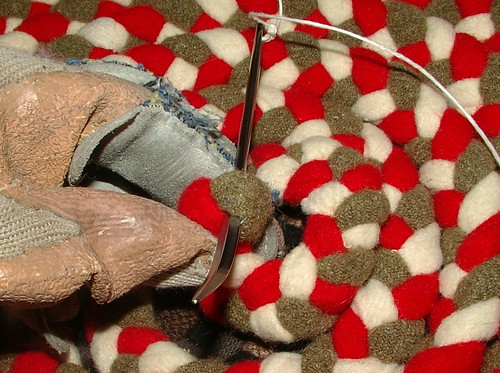
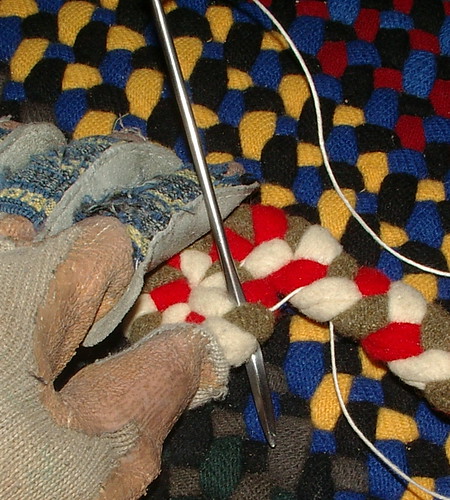
  • glove to protect hand you pull thread with I am right handed the glove is worn on my left but you can wear one on both hands if you want. I have leather thimbles over the fingers of my glove to save my fingers more. All the damage you see to this glove is from braiding same goes for the thimbles.
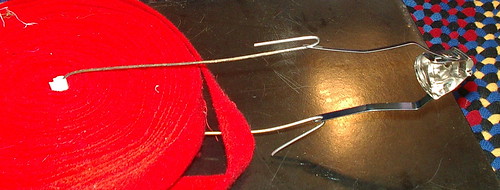
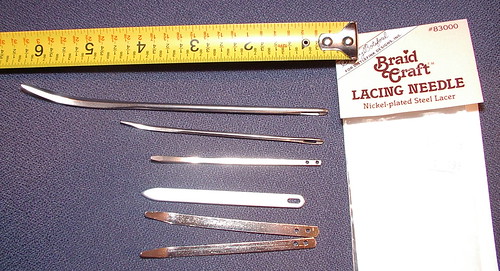
  • bodkins or needles My favorite is the top one it is from my Great Aunt she used it to make rugs over 60 years ago. Next is the one below it found thrifting. The bottom ones are the type you find at most stores in a package like to the right in the photo. I don't like them to short in my opinion. They are hard to manipulate.
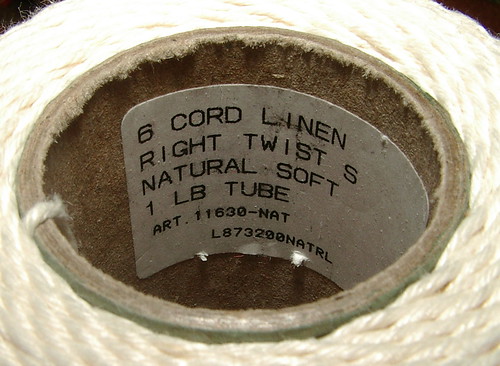
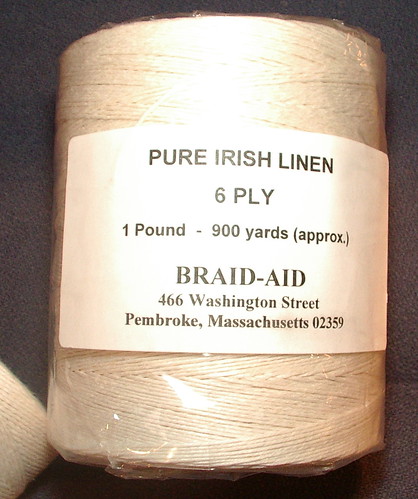
  • 6 ply linen cord. You can also get a nice thick strong cord from any cobbler. They have two types waxed and unwaxed. Unwaxed is cheaper waxed is twice as much. I repaired a few of my Great Aunts rugs right before she died and realized she had used waxed cord on some and unwaxed on others. The waxed cords where still pliable and subtle where the other cords had become dry and brittle. I don't have waxed cord to use but I think for the long run it is better. But it has a draw back it is hard to get a knot to seat in it very well. Thus it makes sewing (lacing) harder to do. But if I had both types of cord I would use the waxed over the other just for the durability of it.
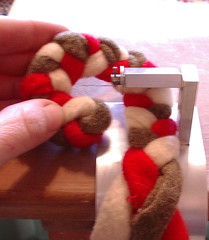
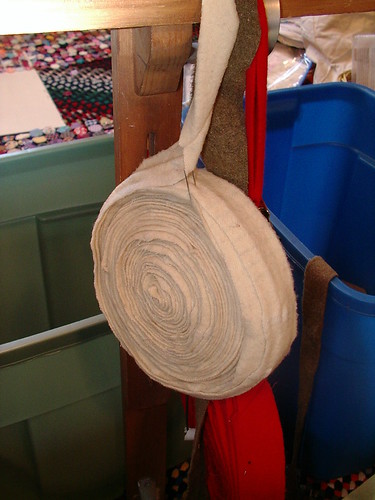
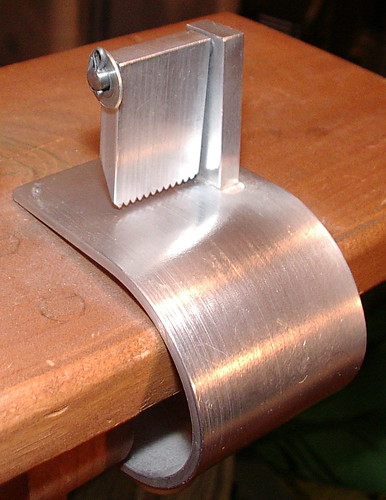
  • swinging gate clamp. This is used when braiding but I realized I didn't show it in the last post with an explanation so I am tossing it in now. This is used to hold my braid when braiding. I can push the braid away from me and the gate swings open to let it move through the gate. If I pull towards me the gate holds firm and doesn't let the braid move very useful when braiding highly recommended. Clamps to most tables.
  • and of course you need a length of braid to stitch together
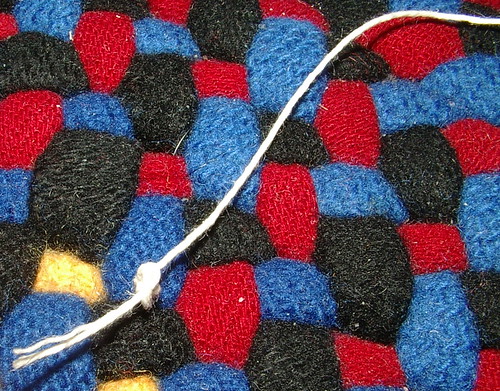
First you will need to cut a length of cord. Tie a knot at the tail and right after the needle or bodkin to make it easier to stitch.
OK on to explaining how to lace the braids together. Just so we all know this is hard to explain in writing for me and easy to demo in real life. So if you have questions please ask as I may have missed a photo but I don't think so.
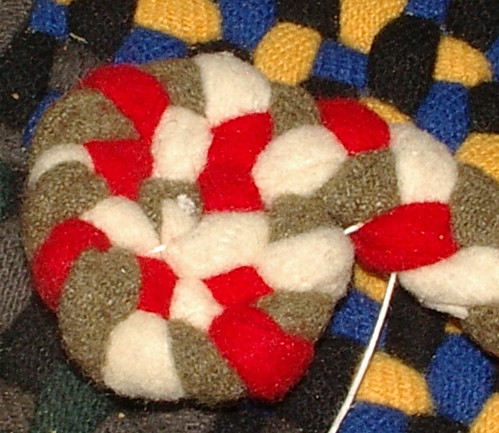
  • Insert needle into the top of the t start make sure to go through some of the fabric inside the braid to secure the knot cut excess threads hanging out
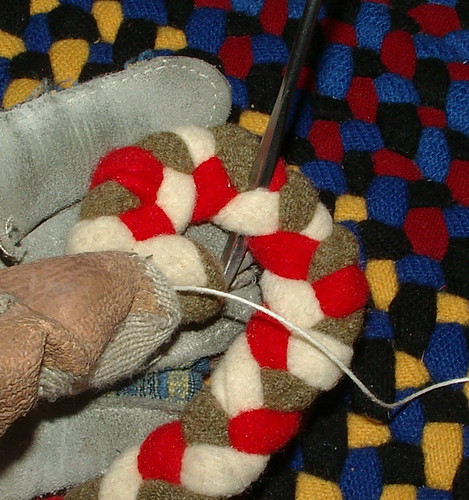
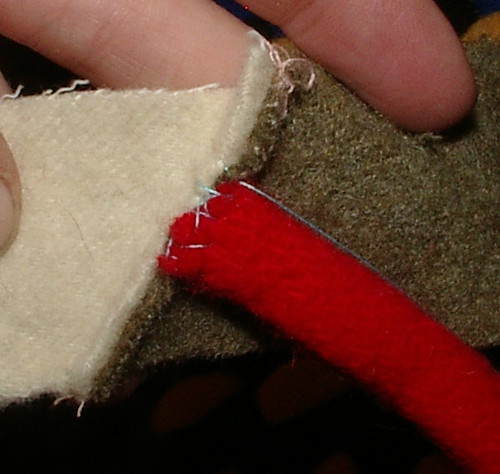
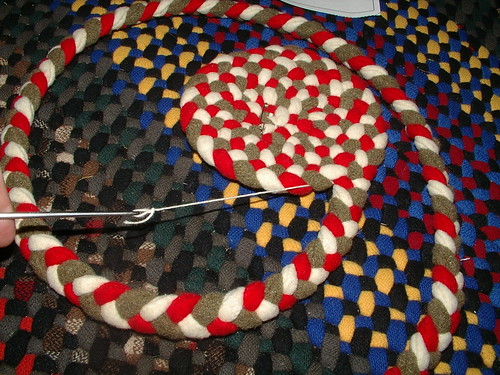
  • pass your needle inside the braid till you pop the needle out on the inside of the curve 3 twists down on the inside curve of the braid.
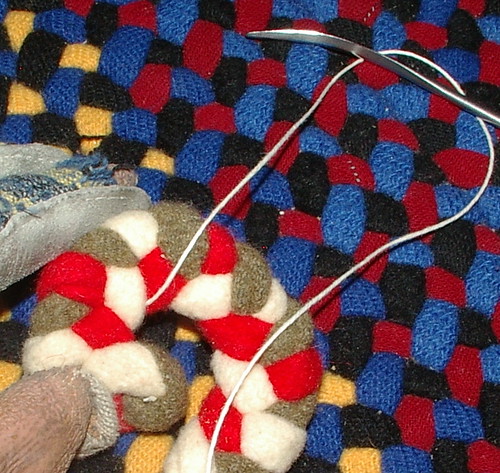
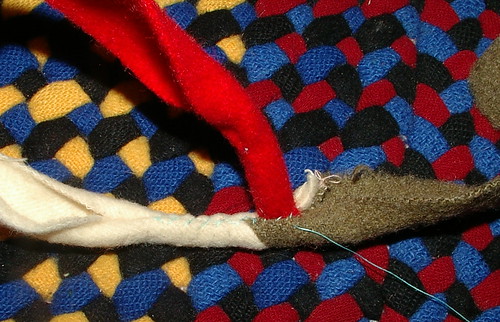
  • go back up to the first l over m and stitch under the braid you are not catching any fibers any more just going in between the strands of the braid.
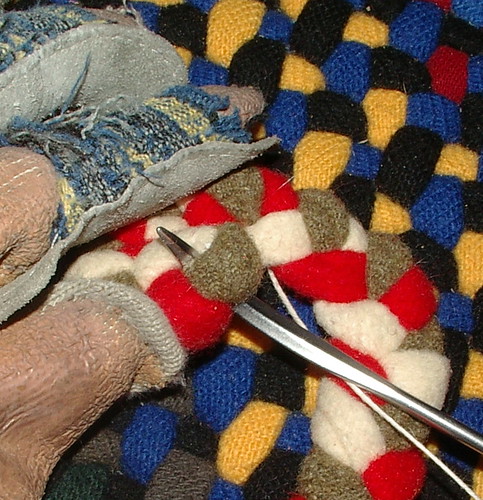
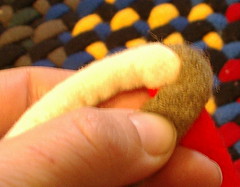
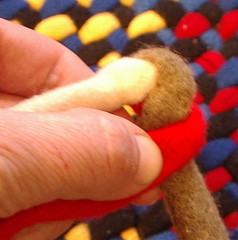
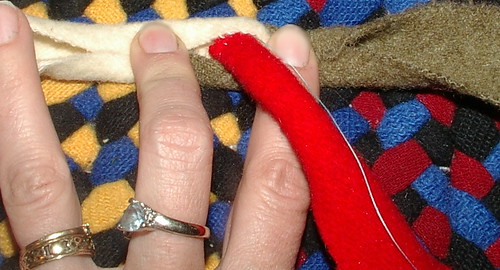
  • now skip the strand next to the spot where the needle popped out of the braid the first time pass needle through the space between the strands. Picture of needle point at the red strand shows that I am skipping that strand.
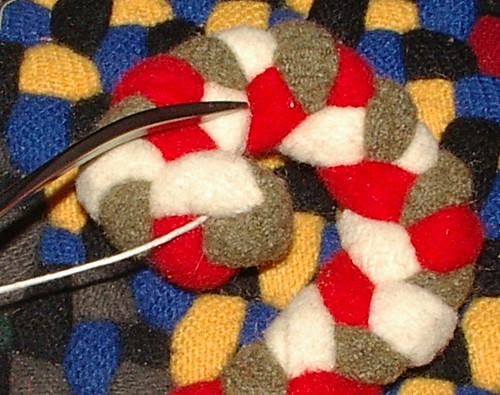
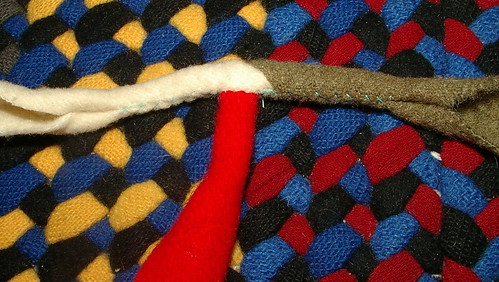
  • back to the top of the t start pass needle under the first r over m
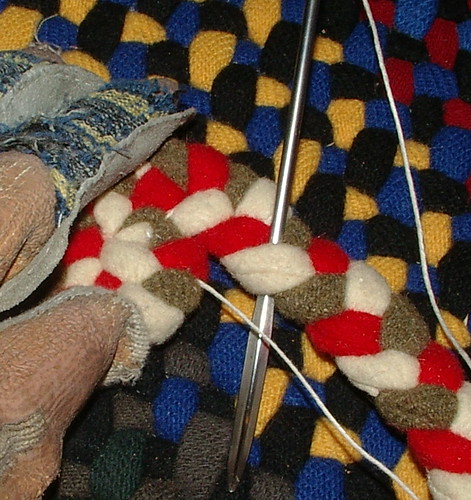
  • back to other attaching new braid skipping next strand on braid stitch under the next. In other words ever other stand is being stitched. In my case I am skipping the reds. These skips are known as increases and is adding bulk to the rug edge to make it easier to make the curves. You only do increases on the braid that is being attached to the rug. You NEVER skip any braid strand on the part of the rug that has already been attached.
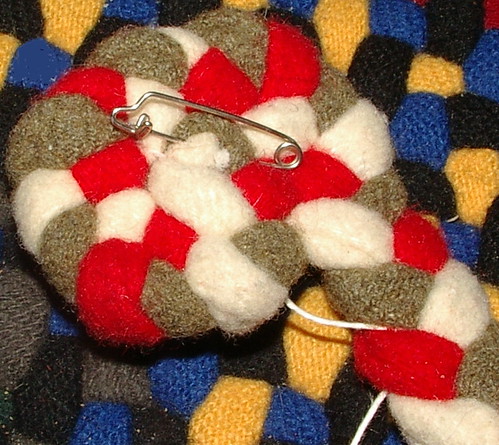
  • back to t star and stitch through the second r over m
  • continue in this pattern until you get to where both sides of the braid you are adding to the rug have three colors in their twists. In other wards till you get past the apple peals.
  • Place a safety pin at the t start pointing away from the t this will point to where you will make all your color changes latter in the rug.
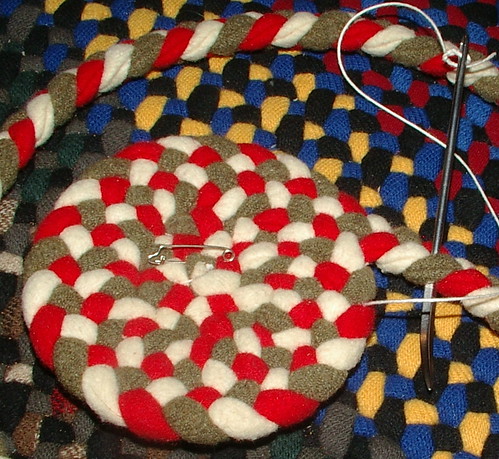
  • You will continue lacing the braid to the rug. But now you only make increases where needed this takes some practice. You can place t pins in the rug to make sure you are staggering your increases. If you don't stagger them your rug will not be round but will have a free form shape especially if you always do them in the same spot. You increase when you feel you have to stretch the braid to make the next lacing. If you don't have to stretch it then don't increase. If your rug is cupping you have not done enough increase tear out lacing and do that part again. If your rug has a wavy effect you have to many increases tear out that part and stitch again with less increases. If your fabrics are not the same weight both of these two things can happen too. It just takes practice to know which is happening. If you switch to a fatter or heaver weight wool do not increase that round. If you switch to a lighter or thinner weight wool you will have many more increases that round. Best to stay to one weight.
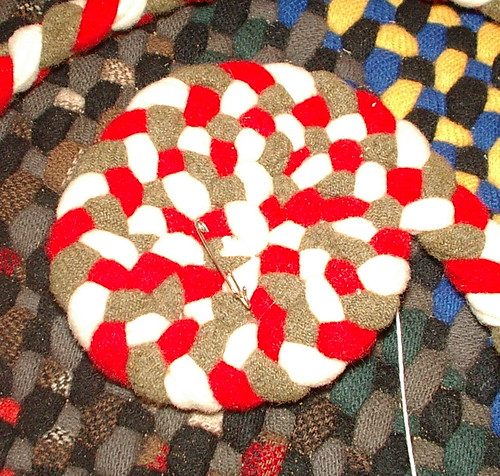
  • Wool rugs are very cushy and thick some people are surprised by this when they make the rug. Trust me your shoulders will know you are working with something heavy.
  • when stitching make sure to pull your linen cord hard to pull lacing stitches together. With wool, cotton toweling, and plain quilters cotton your stitching should not show, with jeans that is a differnt story. As the jeans don't give much to hid the stitches. I like my stitches to be hidden have only made one jean rug for this reason, I don't like to walk on what is holding the rug together. Because if the stitches show that means they are being walked on as well as the vacuum is beating on them wearing them out fast. Since the lacing cord is not as thick as the rug is it wears out soon and you will have to make repairs. This is one of the main reasons I will not buy store rugs as they have little tiny sewing machine thread holding the braids together on the outside of the rug not hidden in side like the ones I make. So it doesn't take much wear to wear out those threads and then your rug falls apart. My Great Aunts (the ones still living) are still using the rugs that they and my great grandmother made over 60 years ago and they still have 60 more years or more of wear left in them. I only repaired 6 holes in over 13 rugs in their house (to hard of work for their 90 plus year bodies) and those holes were made by the kitchen tables legs wearing out the fabric from sitting in the same spot for so long. In other words the rugs where like steel if made well and flipped and rotated often like at spring cleaning time.
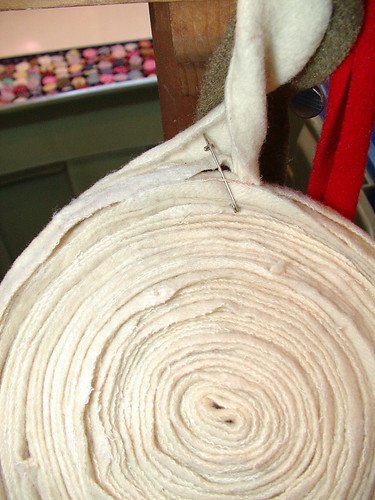
  • When your thread starts to get short also shown in the picture below you will need to add more cording. You can use a square knot or a weavers knot. I use a square knot but both would work great. The weavers knot would be a better choice for waxed thread. When adding thread leave the tails long. So when you stitch the tails can be woven under many braid strands to hold the knot secure and to keep it from untieing and unlacing.
Part 1: Prep work and cutting fabric
Part 2: Will be about sewing the strips together and forming reels
Part 3: About starting a t-started rug
Part 4: How to start a round rug, apple peel style
Part 5: Sewing and increases / tools
Part 6: How to change colors
Part 7: Ending in a taper
Part 8: Butting last one or two rows of the rug for a smooth finish

Monday, April 28, 2008

Part 4: Braided Rug Apple peals

R= right
m= middle
l= left

There are two ways of starting this type of braid once you have a t start

the version I use is listed first the second version the one I don't use is listed second both work great

Start with the apple peal it self

  1. r over mr over m
  2. r over m ( make sure when you are braiding you are keeping the raw edges turned inside so that it continues to have the shape you stitched closed with out the extra stitchesr over m again
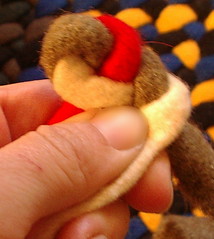
  3. l over m pull hard on the piece of the braid that was left over middle 1 complete apple peal made, this picture, the one below, shows one more step than indicated in instructions above, it shows the next r over m , r over m as well as the l over m talked about above then the second apple peel is started with 2 r over ml over m r over m r over m
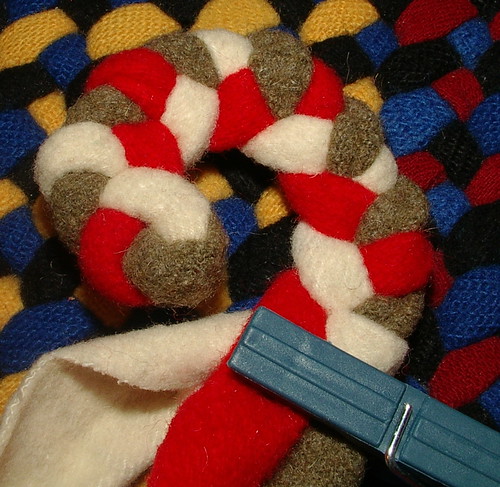
  4. Do 8 of these including the first one in the 8 If done correctly on the left side of the braid will only be two colors where the right side has all three but one color is ever other twist8 apple peals
  5. then start plain braiding, r over m, l over m keep braid tight and firm this isn't like hair where you want a long braid but a short stocky braid. Make sure you are turning in your raw edgesnow braiding straight seams to left
If I can get my husband to do it for me I will make a little video latter and add it to this post showing how to turn ends in while braiding.


Version 2
  1. start with normal braid ( r over m, l over m) then start "apple peal" see above

Part 1: Prep work and cutting fabric
Part 2: Will be about sewing the strips together and forming reels
Part 3: About starting a t-started rug
Part 4: How to start a round rug, apple peel style
Part 5: Sewing and increases / tools
Part 6: How to change colors
Part 7: Ending in a taper
Part 8: Butting last one or two rows of the rug for a smooth finish

Saturday, April 26, 2008

Part 3: Tutorial braided rug T start

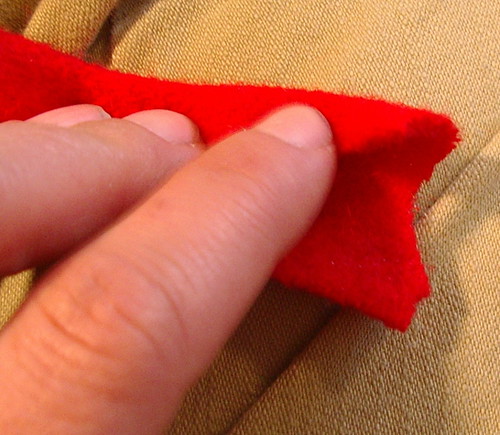
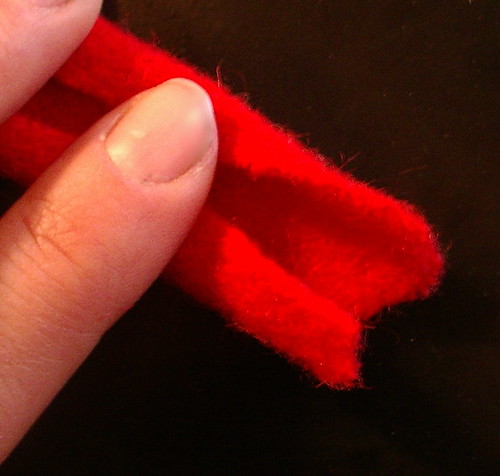
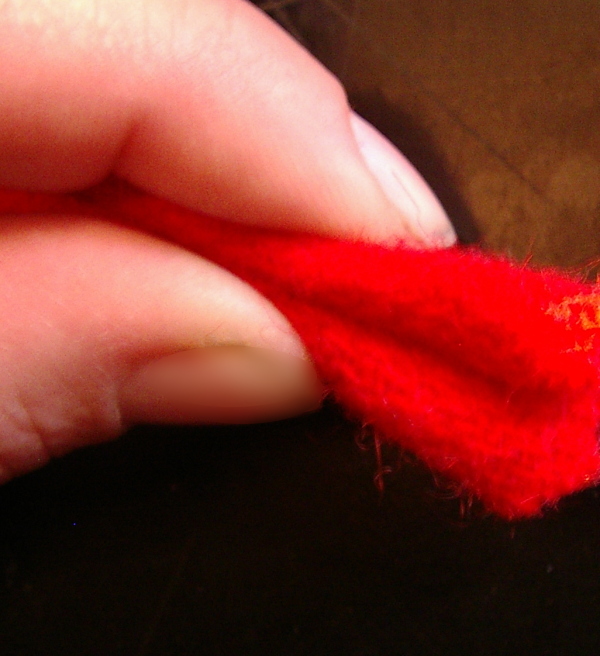
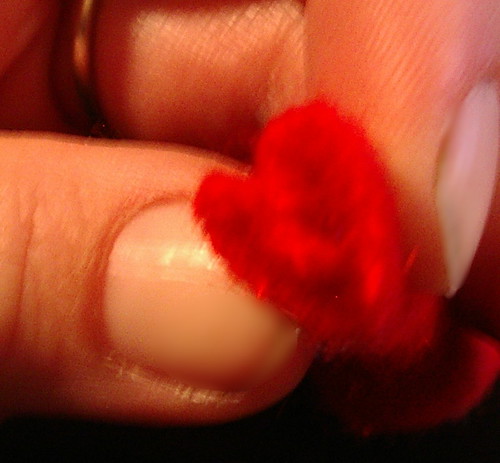
  1. Fold inside strip for the starting of the braid over on itself to hide all raw ends. Fold down top, fold up the bottom, then fold all to center; should look like a heart shape from the end.folding inside of t start braidfolding other side of t start braidno raw edges foldedlooks like a heart from the end
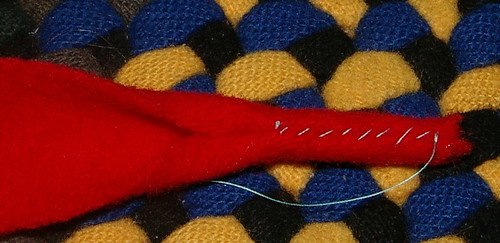
  2. Stitch this tube closed for about 2 inches. I am using bright colored thread so you can see it; usually you should try to make it match your wool color.inside piece
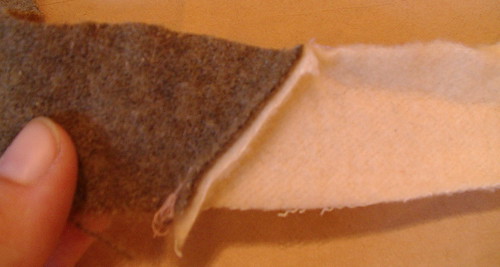
  3. Using the previous seam from last post in tutorial that I showed with the 45-degree angle, we will start our T-started rug. This is the first strip; it is two colorsimage 5
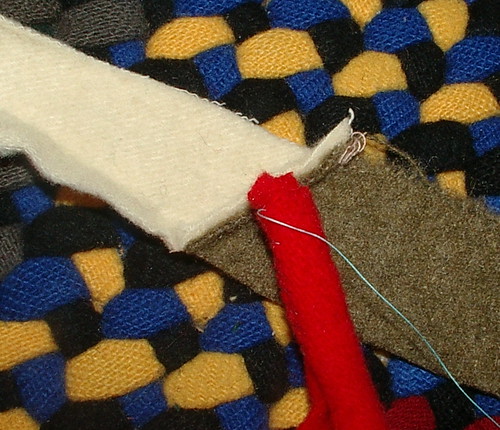
  4. Attach second strip to inside seam of first. I do this by hand; I guess you could do it by machine, but it would be very awkward.attached to wrong sidesclsoe up of attachment
  5. Fold over first the strip (cream and green) and stitch closed for about 2 inches on both sides of second strip (red). When stitching this closed, make sure to stitch both sides back and forth for a strong connection to the steam coming out of the top of the T; also stitch to the red, too, so all is closed up. With this technique, your starts will be very smooth and it will be hard to see where the two top fabrics (khaki green and cream, in this case) are joined together. folding over other sides stitching closed
This is all there is to a T start.
t start now compleat
It is good to start with a light, medium, and dark color; if you start with too many darks, it sort of looks like a bulls eye in the middle of your work. Now, if you want that look, go for it; not every one does.

On a side note:
Sorry for the messy nails; stripping wool gets lots of wool-fiber dust under your nails, not a neat job. Expect to get a little fiber dust under your nails and all over your house.


Part 1: Prep work and cutting fabric
Part 2: Will be about sewing the strips together and forming reels
Part 3: About starting a t-started rug
Part 4: How to start a round rug, apple peel style
Part 5: Sewing and increases / tools
Part 6: How to change colors
Part 7: Ending in a taper
Part 8: Butting last one or two rows of the rug for a smooth finish

Rug Braiding tutorial updates

handmade rugs. Get yours at bighugelabs.com/flickr
I am going to try and post at least three more parts of this in the next seven days. That way, if people want to get it started before their kids get out of school, they can. This is a nice summer project all ready and set to go when they have a minute here and there to add to the length. If you didn't guess it already, it was my day off today and no school, so I got to work on my tutorial.

Part 1: Prep work and cutting fabric
Part 2: Will be about sewing the strips together and forming reels
Part 3: About starting a t-started rug
Part 4: How to start a round rug, apple peel style
Part 5: Sewing and increases
Part 6: How to change colors
Part 7: Ending in a taper
Part 8: Butting last one or two rows of the rug for a smooth finish

Part 2: Braided Rug tutorial

Sewing Strips Together

stacks of wool for making braided rug

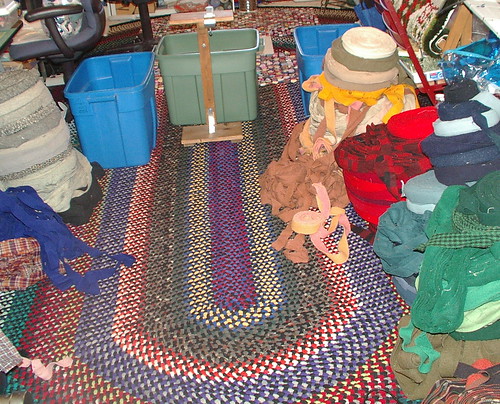
So, I cleaned the sewing room so I could instantly make a mess with this project. Above photo: stacks of wool for making the rug.

The strips are sewn together at a 45-degree angle. This is used to change colors and to add more of the same color to the current strip being used. This is also used in the beginning when you have three colors starting at the same time.
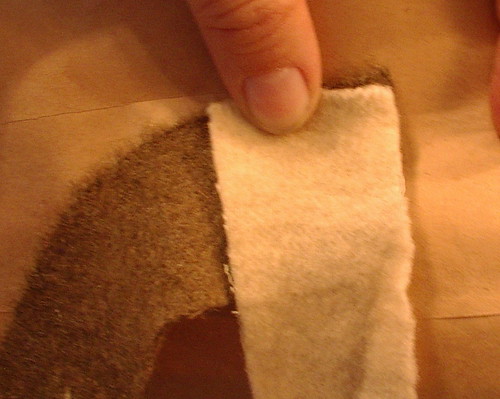
  1. Lay ends of wool strips that you have cut at right angles to each other. image one
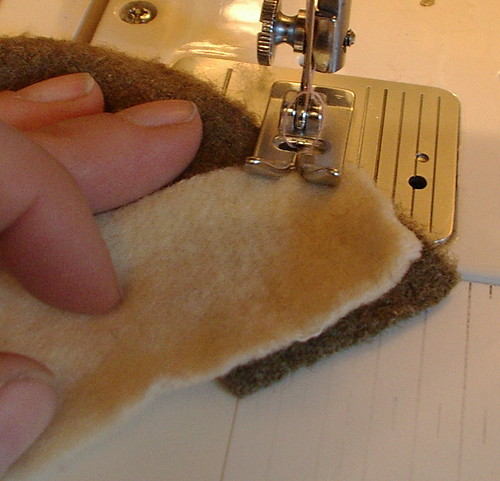
  2. Sew from corner to corner, a 45 degree-angle, right sides together. image twoimage 3
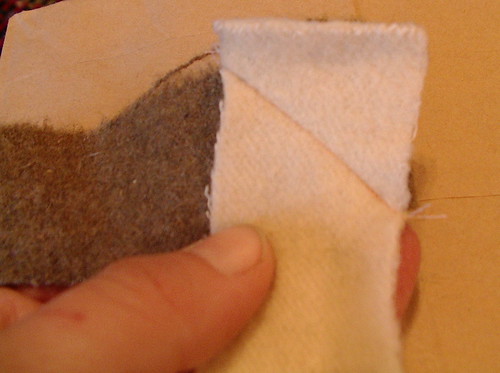
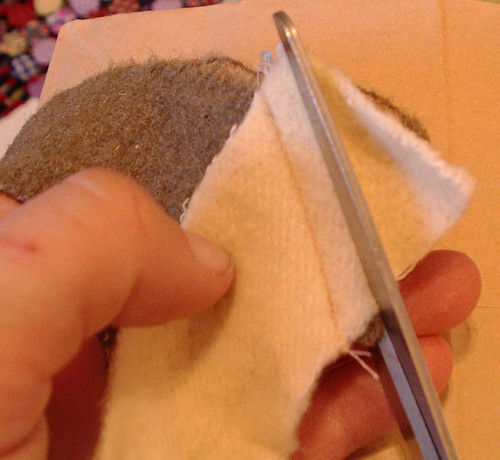
  3. Trim off excess wool; leave 1/4 to 1/2 inch-wide seam allowance. image 4image 5
The reason the seam is sewn at a 45 degree angle is to reduce bulk in the braid because it spreads it out over about an inch instead of putting all the bulk in one spot.

When braiding, you need one of your strands to be short; there are a few ways of doing this.
  • One is to leave two long strands and constantly add to the third strand.
  • Another is leave all three strands short and add to all three as needed.
  • I don't like to do either of these methods because it breaks the rhythm of braiding. So, I leave two strands real long and the third strand is left sort of long, but in the form of a reel, which makes its over-all braiding length short.
You can do any of the above that works best for you. Two are pretty much self explanatory, the last I will explain a little better.

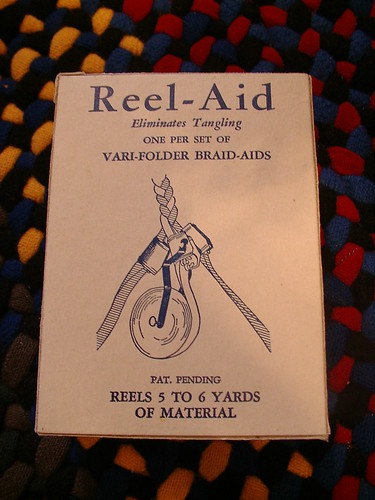
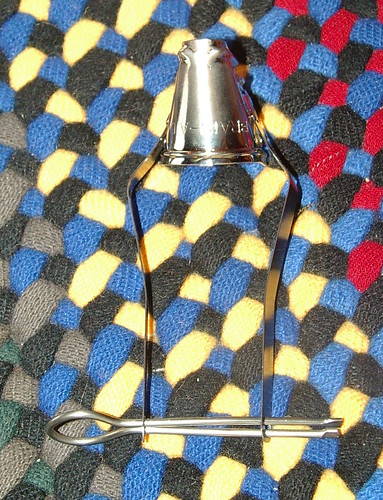
I like using a braid aid reel; the only thing was, it didn't hold enough in my opinion - only 5 yards. reel aid by braid aid
reel aid
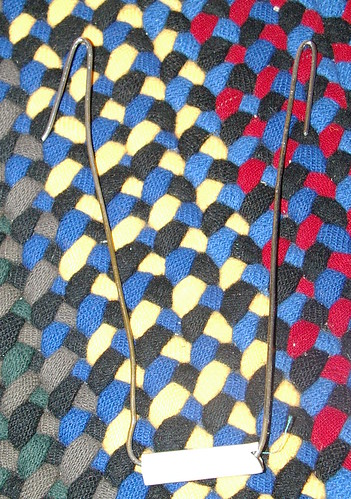
So, I bent an old wire clothes hanger and attached it to the bottom of the reel tool to make it longer and hold more. At the bottom of the bends I placed a piece of PVC pipe to help the wool roll around the wire better for ease in braiding.
extension for reel aid I made
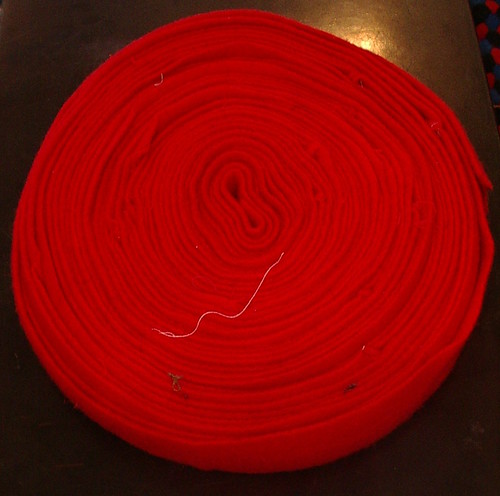
Wool wound in a circle/reel with a hole big enough in the center to accommodate the pvc pipe.
wool wound into a reel
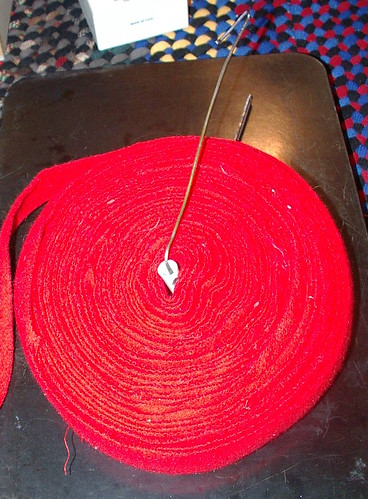
Extension inside wool.
with extension added
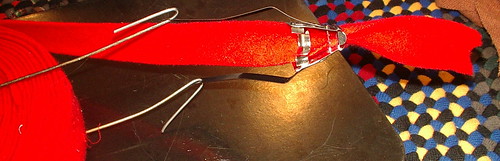
Remove pin from Reel aid and attach to extension.
extension on reel aid
Wool strips feed through the tool.
strip fed through reel aid

I don't use the reel to fold the fabric; I just use it to hold more fabric. You can use braid aids on all your strips to help you fold, especially if you have arthritis or something of that sort. Personally, it is easier to braid without the gizmos and creates less fiber dust, too. That is why I now prefer to use just the one, the reel, to speed up the braid time by not having to stop so much to sew more strips on. But I leave the other strips without the tool because it is faster for me.

If you don't have, or don't want to buy, a reel-aid tool, you can do the same thing with a safety pin and just undo a loop every time you need more of the strip to braid. I do this, too. I am trying to give you as many options as possible on how to do this so it is the cheapest for you in the long run in case you do not want to invest in a lot of tools.
imgp7785imgp7788

Part 1: Prep work and cutting fabric
Part 2: Will be about sewing the strips together and forming reels
Part 3: About starting a t-started rug
Part 4: How to start a round rug, apple peel style
Part 5: Sewing and increases / tools
Part 6: How to change colors
Part 7: Ending in a taper
Part 8: Butting last one or two rows of the rug for a smooth finish

Wednesday, April 23, 2008

Here is what is left to do

part left to straighten
As you can see, lots of boxes and lots of fabric and supplies are all over my sewing room. Biggest mess is on top of that table where I work on projects. Like I said, it is nearest to the door which makes it a dumping ground. All the fabric on the table is 100% cotton; the fabric behind the door is 100% Pendleton wool mill ends. I use it, the wool, to make rugs and other such things. This isn't stripped yet because I have about ten boxes of wool (the size of the green and blue totes in this picture) stored in my garage that is all ready to make a rug. For those who are waiting for the rest of the rug tutorial, the next installment or two will be on Saturday. I hope you have all your fabric washed and stripped, ready to sew and braid. If you click on the picture, it will take you to flickr where there are all kinds of notes on this picture.

Tuesday, April 22, 2008

Progress on Studio

studio room in my house
I have the studio about 3/4 ths of the way straight. Too bad the last 1/4 is the worst part because that is my table where I work on most projects. It is also the closest to the door, meaning the easiest to dump things on, too. The sewing table, kids art area, and the light table are pretty much straitened up. The room is about 12 feet by 23 feet, so it is actually a pretty good-size room. Too bad the ceilings are pitched, or I could stack my boxes taller and have more floor space; oh well, better than what it was in the last house. The rug on the floor in this room used to be in the front room at my old house, now it is in my sewing room. Less traffic and less likely to get mud on it now, which is good because I don't think I will make another that big in the near future.

Monday, April 21, 2008

Some of Todays floral

funeral
Normally when I do funerals for people who are young, they make me sad. This set of floral is for a twenty-year-old woman. Her mother just happened to come into my shop while I was making these. The young lady in question had an aunt who was a florist. This Aunt was making floral arrangements at home to take to the funeral, and they needed floralife, a floral preservative food. After she told me they where making florals for her deceased daughter I asked what her daughters name was. After she told me, I got to tell her I had four arrangements for her daughter, too.
funeral
I was told about this remarkable young lady who had Downs Syndrome and who loved the world, and from what I can tell from the funeral cards I had to write, the world loved her too. Her mom was all excited to see what I had made and asked if it was ok. After I showed her, she said her daughter would be so happy with those, and she herself was excited. This made me feel good because usually we just have the delivery driver take them to the mortuary and we only hear about complaints, not the happy side. After having done so many children and young-adult funerals lately, this was a very nice change for the day.
funeral
Two of these are 50 dollar arrangements and one is 40 dollars and the pink one is 95 dollars.
funeral

Studio Room

My life has been so busy lately that my studio has become a dumping ground for half-done projects instead of a workable room. I have been working on getting it back into shape. See the vacuum in the back of the photo. I have lots of projects I have to get done right now, like my tutorial on making a rug and finishing that afghan repair; both need lots of room and the room is big but not when it is messy. It may not look like it from this photo, but it is an improvement. All those boxes you see are full of fabric, thread, lace, ribbon and so on. This is, of course, only half of the room; the other half I am still working on straightening.

Saturday, April 19, 2008

QA: To answer another question...

I received this email on April 17th:

I just found your web site. I really like it. It seems real, not scripted. :+) I love your work also. :+) I was wondering if you could help me with a pattern in a book you have!!! I can't seem to find anything about it on the web, and don't know any one who crochets. LOL. It is in the crochet year book volume 2, the Granny Girl Purse and Headband. Here is what I am having trouble with..
RND 8: join black to any corner ch-2 sp; ch 1, 5 sc in same sp; *sc in next 21 dc, 5 sc in next corner ch-2 sp; rep from* twice more; sc in next 21 dc; join in first sc.
How do you do 5 sc in that same sp?? It creates a chain, is it supposed to be like that? Or am I doing it wrong? I am at a complete loss with it, and am trying to make this for my niece. I would really appreciate any help you can give me.
Forever,
Jo

I don't know how many have this book but lots make granny squares so here is my answer....
First, if you are not the person in question, I will not post the entire pattern as that would be infringing on the owners copyright. But for explanatory purposes of the question, I left what she had written about round 8 so we would all be on the same page which, in the book, happens to be pages 138-139, and 162-163. The book is from "American school of Needlework" Volume 2 book 1336.

Please excuse the dots of blue paint on my nails and under them; it is from making a floral arrangement yesterday and I have to wait till it wears off. See previous post about work fun.

Ok, on to the question...

First off, on the previous round you only have chains in the corners on the sides of the granny; there are no chains, just sets of 3 dc.

This is different from the previous rounds. Just making sure you have the previous row correct. For some reason for the set up of the edge the author has you sort of decreasing by removing the chains in the previous round. That is a side note back to question.

You slip stitch into the space that the two chains made on the corner; do not slip stitch into any of the chains.

Showing slip stitch to attach to work
The ch1 gets you to the right height for the row to begin and counts as nothing in your pattern; just a height thing.

Showing chain 1 to get to right height.Showing start of first sc in ch 2 space. Also showing crocheting over tail to encapsulate it into the work so you don't have to finish so many threads at the end of your work.
Now, in that same ch 2 space on the same corner where you joined, you are going to place 5 sc around those 2 chains.

Showing all 5 sc in chain 2 space, sorry bad photo.Showing the 5 sc in corner and the first 5 of 21 sc across side of granny square.
The next 21 stitches are in the top of the 7 sets of 3 dc between corners. then you place 5 sc around the next set of ch 2 in the next corner do this all the way around. It isn't forming a chain; it is defining your corners with 2 sc per side and 1 for your corner point.

Friday, April 18, 2008

work fun

more sites at husbands work
When I drop off my husband for work each morning I am usually greeted by this sight. These geese, and others that have a lot more color, and a bunch of mallard ducks are always at my husband's work because there is a small river within 20 yards of the building, if not closer than that. The funny thing is, there are some real busy roads near his place of employment. I have seen traffic stop for a duck to waddle across the road. Doesn't matter how much you honk or anything, they own this area and are not going to move for anyone. This morning these geese where having a tissy with each other; it was funny to watch, too.
sites at husbands work
start of arrangment my doodle
Today at my work I got to make this arrangement; it took forever because of the way these things are assembled. But it came out well; it isn't quiet done in this photo because the bottom mums are still white and need to be blue. I ran out of floral paint, so the sister store had to send some over, and the florist after me put the finishing touches on it, I hope, after I left and before the customer arrived. If you are from Utah, or you are a member of "The Church of Jesus Christ of Latter Day Saints," you probably know this is one of the symbols for BYU ( Bringham Young University).
arrangment almost done

QA Questions and Answers

I get lots of people who send me emails on how to do certain techniques or how to understand patterns. So I made a new label that is in my tags on the side bar labeled QA. As I get these questions answered, I will post them here so others can find them easily and so the person with the question can find it easily most of all. I went back into all my old posts and added the QA label to 15 of them to help people find answers from the past.
Thanks,
sunshine

(Hope this helps!)

Tuesday, April 15, 2008

100 + holes

A few days ago I received a phone call from Heindselman's letting me know they had sent a referral my way for a repair. This is not a new thing; it has happened alot over the past 13 years . They send people to me to repair their vintage items. A few minutes later I received the call from a very nice lady who had a table cloth (wink wink) that had belonged to her grandmother and had been on the dinner table for years at her grandmother's house.

The story goes that the grandmother passed away, and the tablecloth went to the daughter, who was just going to take it to the thrift store because of all the damage to it. Before doing this, she called her own daughter (the granddaughter to the lady who had passed) asking if she wanted it. Yes! was the resounding answer. After contacting Heindelman's and being refereed to me, she called and we had a conversation about said tablecloth. I asked if she was sure it was a tablecloth because most times they are actually bed cloths. She was certain it was. Then, we discussed the damage and when I would travel to her house to see it. After seeing it, I was certain it was a bedspread because it had notches crocheted into it to accommodate bed posts and only had an edging on three sides; definably a bedspread.

I wish I had looked at it a little closer! It has more damage than I thought it did. 100 + holes; to be exact, my estimate on the repair may have been way too low. That has never happened before; usually I am with in 20 dollars of my preliminary estimate. Once I get it home and can asses the damage more, I usually do a follow up estimate. I have yet to work the pattern to see how long it takes, then I have to figure out how long each hole will take to repair, then the cost of supplies. Not to mention I have to figure out the hook size, tension, and match a thread that probably hasn't been made in over 50 years or more. I like challenges like this, and the people who get their family heirlooms back are happy to have them whole again, instead of holey.Old sewing thread repair top left.Holes in the edging in Solomon's knot stitch (also called lovers knot, it has a few more names, too).Holes in mesh stitch around in the edgings.More holes in the edgings.Holes in the center of the medallions in the center of the afghan.

These things are bigger challenges in that other people, over the years, have tried to make homemade repairs in all the wrong ways with sewing thread which cuts through the crochet thread, actually causing more holes in time plus the sewing thread pierces the crochet thread when the needle was stitched through everything to hold it together. This means that I have to either spend lots of time cutting sewing thread, or just cut that section out and spend lots of time re-crocheting a bigger section than if they had just left it alone. Either way, I have my work cut out for me on this one. Enclosed in this post are a few of the holes I get to repair.

The repair to the left isn't sewing thread; it is crochet thread that whoever tried to repair the damaged just kept winding around the stitches. These type of previous repairs are also annoying because it takes forever to unwind that mess. The repair the previous person did is very clunky and big to look at, too; not neat and invisible. I don't make repairs like this.

The center section is made up of squares that are then sewn together (see first picture in post).

Thursday, April 10, 2008

This is budgie

This is the school pet at my middle daughter's school. We get to bird sit her for spring break because we are not going anywhere. The last time we bird sat her, she wouldn't come out of her cage . Right now, as I am typing this, she is sitting on my head; yep ,that is my hair in the photo that I took a few seconds ago. Not the best photo. Now she is sitting on my hand trying to help me type. I am not sure which is better -- in the cage or so at home that she is everywhere. Both are a lot distracting. It was depressing to have a bird so attached to her cage that she would never come out and peck at the cage door to go back in; now we have the opposite problem. At least she feels at home in our house this time. Ten days of this will be weird.

Irish crochet bonnet

imgp7681
Progress on the back of the bonnet. There are a few more rounds for the back, and a round of roses (not totally made) for the back still, too, before I get to the brim. Pattern has been updated also.

Monday, April 07, 2008

To answer a question on Irish bonnet

thread hook and rose
I have had a lot of questions recently on an Irish crochet bonnet pattern I posted a long time ago. I have not ever made all of this pattern so I have not worked through all the nuances of it, yet. I am, as time allows, working through it and redrafting the pattern as I go. I was asked to post photos of the rose in the bonnet. Top photo shows front with the thread and hook I am using; the bottom two photos are showing the back of the rose. I am currently revamping the pattern; it is posted where I have gotten to on that project.
backside
back side

Saturday, April 05, 2008

Old sweaters/ Conference Saturday project

start of sweater afghan
So, what to do while listening to conference on Saturday Morning and afternoon. Get rid of the pile of old sweaters sittings at the foot of my bed that I have been meaning to tear apart for awhile. So, as you now know, I had a bunch of old sweaters (cotton rayon blend); these all had some sort of embroidery. Not really my style any more, and most didn't fit well, either. So what to do with them?
  1. First, salvage all the buttons; lots of good MOP (mother of pearl) buttons on these sweaters to be saved, and a few cool beads. After you pillage the buttons and such, what next?
  2. Cut as many 9 1/2 inch squares as you can, save short sleeves (I have another project for them in mind) and the large scraps (same project).
  3. Cut white 100% cotton fabric squares, also 9 1/2 inches square. (I have not done this step, yet). I plan to back with cotton fabric to help prevent the wavy look I have seen on other such afghans. Don't know if this will work, but I will give it a try. I plan on using 1/2 inch seam allowance. Bigger than normal, but I am hoping this will help with some raveling that may happen.
  4. When all are sewn together with a bat and a back, I want to tie the front to the back with crow feet quilting. A sort of quick quilting-tie with an embroidery look.
  5. Bind edges; I am thinking old silk from same pile of clothes to get rid of, or old-fashioned satin blanket binding. There are also jeans in this stack to add to my jean braided rug.
I think it will be cute and if not, it will still useful.

flickr issues

Sorry if it is taking awhile today for things to load; flickr seems to be having issues, again.

I just thought I would post a positive thought for the day.

"Talk unbelief, and you will have unbelief; but talk faith, and you will have faith. According to the seed sown will be the harvest."
Ellen G. White

Thursday, April 03, 2008

Part 1: how to make a braided round rug (prep work)

husbands rug ( I made it for him)
I am going to do a series of tutorials because it will take a few posts to make this. Many people have asked how to do this, as well as a sister-in-law. So, for hers and your benefit, here we go with the first tutorial on how to make a round braided rug. Why round? It is the easiest to make first, ovals next, corners and odd shapes the hardest and last.

So, here is the start of the round rug.

Supplies for this step:
  • Scissors/ruler or rotary cutter/mat
  • fabric can be wool (easiest to work with if you are not allergic to wool, that is). jean (denim, hardest on the hands to work with), cotton (very thin; won't last long), cotton toweling (easy to work with, just messy when cutting strips and braiding -- little tufts of toweling everywhere), or any thing you like (I hate using synthetics for this, but if you just have tons of polyester, go for it just [eww] don't show me, I don't know how it is to work with because I have never used it, nor do I want to)
  • washing machine/soap/cycle on hot water, dryer

Steps in prep work:

  1. Acquiring the fabric. You can collect old towels to use in making a bath mat, or worn out jeans to make a kid's playroom rug. Some people use scrapes of cotton yardage that they will never use to make anything else. I don't do this because I feel it is too much work to use such a thin material. The result is lovely, but it takes 5 times the work and supplies and doesn't last even half as long as a wool one. You can use wool mill ends if you have a place near you ,such as Pendleton woolen mills. Now this I do like: cheap price, but high-quality material. If you get your fabric from old clothes, you will have to tear down the old clothes getting rid of all seams and such because they are not useful at all. This is a lot more work, but if you have clothes from a deceased relative, it can be rewarding, too, or if they are clothes your children have worn and such.
  2. Wash all fabric first in very hot water to shrink them and set colors, and dry on high heat in dryer to shrink it as much as possible before use. This will also help in getting rid of and killing any moths that may be in the fabric, if using wool. I also, afterward, stored my wool in big black garbage bags with moth crystals for three weeks to make sure I don't bring moths into my home; that would be a nightmare at my house!
  3. Cut fabric into 1 1/2 inch-wide strips, for wool. For jeans, I would use 3 inch-wide strips, and same goes for toweling and cotton fabric. Cut strips with the grain or cross grain of the fabric, never on the bias; bias has stretching issues when braiding, and that is not good. You can tear the fabric; for this, cut small snips at one end of the fabric and just tear to the other side. This makes sure that all your strips are uniform and with the grain or cross grain of the fabric. If you want to cut all the fabric with a rotary cutter, that works, too; just might be on the bias if you are not careful...

Part 1: Prep work and cutting fabric
Part 2: Will be about sewing the strips together and forming reels
Part 3: About starting a t-started rug
Part 4: How to start a round rug, apple peel style
Part 5: Sewing and increases / tools
Part 6: How to change colors
Part 7: Ending in a taper
Part 8: Butting last one or two rows of the rug for a smooth finish

These tutorials will be all about making a braided round rug. If after this everyone likes the tutorials, I will add one on how to make an oval rug; it has a different starting. I will also explain the math involved in the increases and figuring out a finished size of an oval rug. This is useful if you want to make a rug for a special space that you will want to fit with an oval.

I do have a group on flickr about handmade rugs; you are welcome to check it out.

hand made rugs. Get yours at bighugelabs.com/flickr

Jean rug I made laying on top of a wool rug I made. I was still working on this jean rug when this photo was taken (and still currently am making it bigger). I don't keep rugs on top of each other as a normal practice.

finished rug

Below is a rug I made from towels that had been well loved and became real worn out and old. They had all been gifts to us at our wedding, so I wanted to save them and make them useful. Thus, a rug was born made out of towels to make a bath mat. You can use brand new towels; it will give you a much softer and fluffier rug. Warning: when cutting towels, it is the messiest of all the fabrics I have mentioned. Do this, the cutting and braiding, in the garage or outside, or you will have a huge mess to clean up.

bathroom towel rug oval

This is the wool rug, known in our house as the ladybug rug, this is below the jean rug in the other photo. two up.

lady bug rug

All the pictures above are of oval rugs, except the first one. I have made many round rugs, but the pictured one I have given away to family members. Even the one in my home was a gift to my husband, so I don't actually own that one, either. The top round rug was never finished because, at that time, I didn't know how to butt the ends of a row so it ends at the tapered row. Both ways are fine; one is just stronger. At some point I will go back and finish my husband's rug, if he lets me he likes it the way it is. I think it still needs two rows of butted braid.

Wednesday, April 02, 2008

Floral Cake

birthday cake flower
I made this today. It is a flower arrangement in the shape of a cake. It has a ruffle for the bottom, candles on top, and a rose in the middle with ribbons on the sides as frosting decorations. It is always kind of weird to make these types of arrangements because the stems on the flowers are only about 1 inch long. You feel like you are killing the flowers much faster than you should by making them so stubby. We have cake-like boxes these are delivered in to make them look more like a cake at presentation. You can even order them as just a slice of cake. Not sure I would ever order one of these, but thought it interesting to show and photograph. Not a great photo; sorry.

Update for Turkish lace fans

The nice lady who runs the site on Turkish crochet has agreed to let me use her stuff (crochet images); in trade, she gets to use my stuff (patterns and tutorials for this type of lace pulled from her images), as well. So in my spare time I'll be doing that. Ha ha, like I have that; but, I am going to try real hard to find some so I can work on this.

Below are the first set of posts on her blog;some are not lace edgings. Those with stars I will be skipping. The images below are hers, not mine, to show you what I will be working on. I will work on some that are not edgings if it is a simple enough pattern. Because I am not able to hold the lace in my hand, my stitch count may not be the exact as hers because I cannot move the stitches around to see the hidden chains and things of that sort. But, the look will be similar and just as useful.