

Showing posts with label english paper piecing. Show all posts
Showing posts with label english paper piecing. Show all posts
Thursday, December 15, 2016
English paper piecing
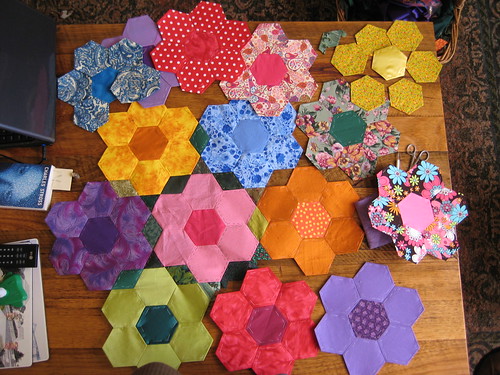
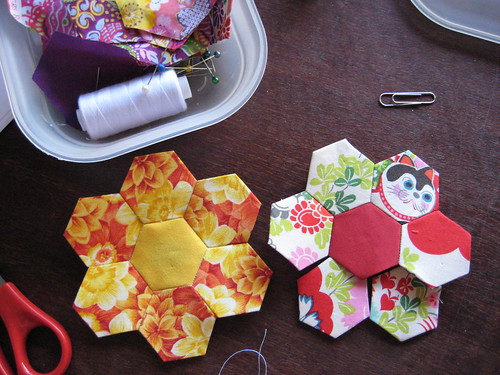
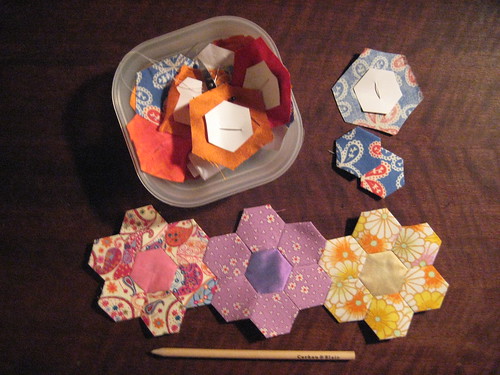
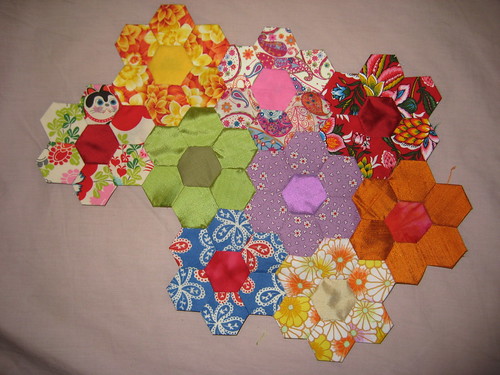
So China, my oldest daughter has started to teach herself English paper piecing. using the popular tutorial on this blog. She had seen me do this for years but wanted to do it too. So she grabbed a box of fabrics I already had cut and prepped for a quilt. She is using my thread and my supplies of paper pieces yep she has it easy to learn how all the time to prep was already done for her but she still has to do all the stitching and figuring out of the placement and pattern she wants to use. So far so good. She will have to cut some supplies in time if she wants to make this a big quit. She will also have to order some hex pieces but for now she is enjoying the ease of English paper piecing. Plus congratulations to her for finishing her first semester at collage... So much fun to go to collage with one of my own kids.


Tuesday, November 09, 2010
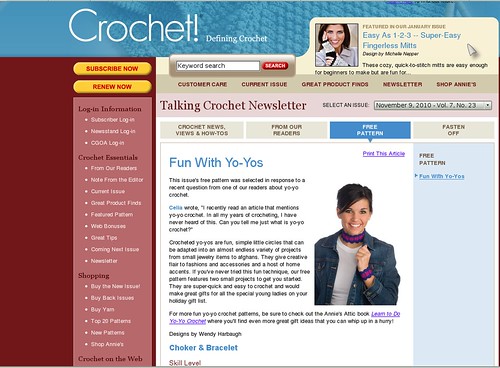
Free yo-yo crochet pattern on line

The choker and bracelet pattern I did for crochet magazine is now available on line for free. If you are interested in starting a quick and simple pattern this is for you . You can use the perle cotton it suggests or knit cro sheen.
Thursday, August 27, 2009
Two projects but all hexes
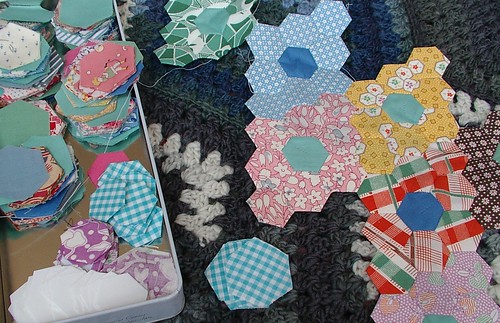
It might be hard for you to see but there are two projects being worked on in this photo. One is obvious a hexagon english paper piced quilt ( small wall size) tutorial here. Which happenes to be using the real thing vintage feedsack fabrics. The other is right below it and is an all wool afghan made using this tutorial. Still have some work to do on both of these. You may not have seen me for a few days but that never means my hands are doing nothing they are always busy.
Monday, July 27, 2009
An interesting turn on English Paper Piecing
Have you seen this tutorial. I think it is such a nice new concept on EPP. Sort of like a yoyo quilt or Cathedral windows in that as you add the pieces to the quilt you are done with that piece don't have to go back, and you quilt as you go so thatis already done too. Wish I had thought of it but it does open up ideas for me. I will have to try this in the future. Here is a goggle translation into english. This tutorial was found through a link I saw on this blog.
Tuesday, January 15, 2008
English Paper Piecing Question
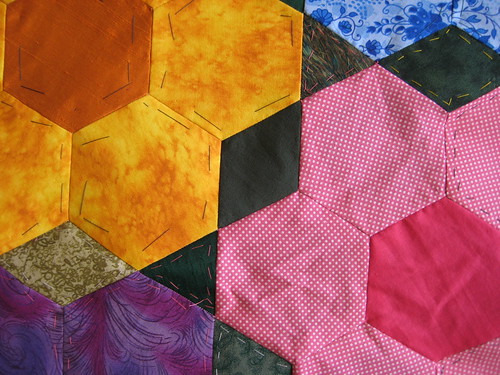
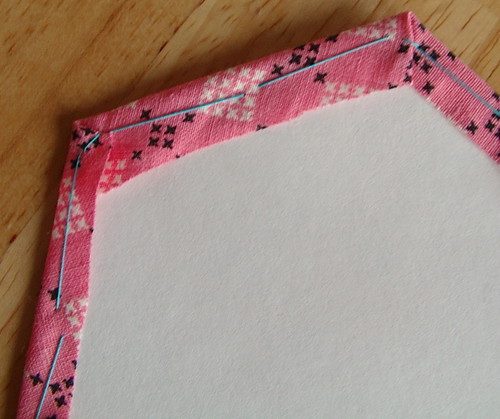
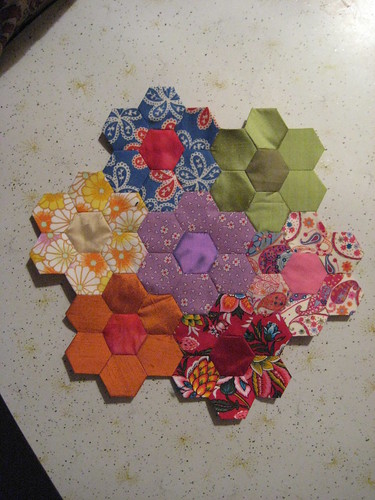
In the way I do it, all you have to do is cut six small threads; just six small nips of the scissors, then pull the papers out (which saves time) and just leave in the basteing threads.

Tuesday, November 20, 2007
Part 1: How to Make a yoyo Advent Calender
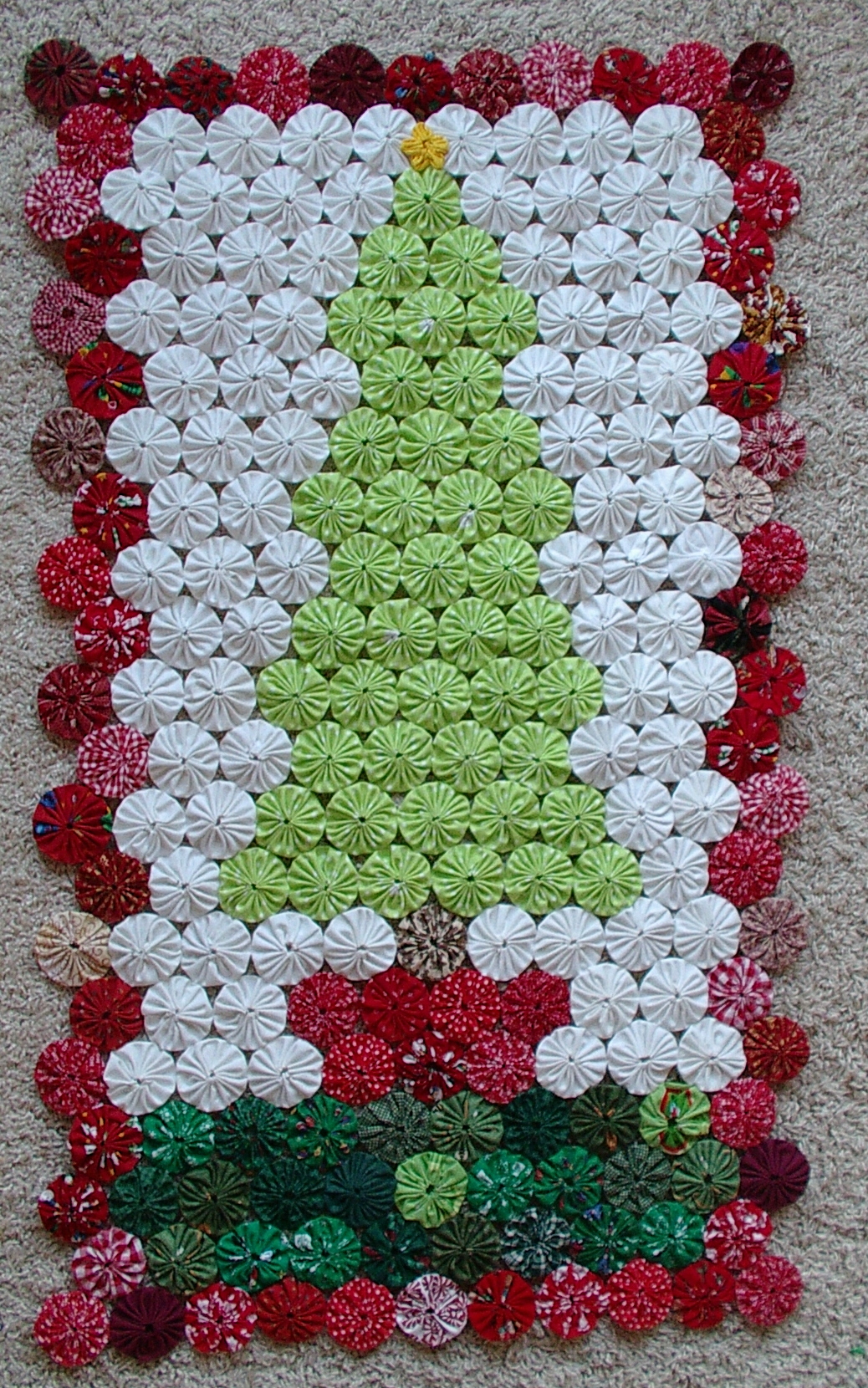 This is the start of a continuing tutorial. This will show you how to make the wall hanging part of the calendar. Then, each day I will post how to make one or more ornaments to hang on the tree 'till I have 25. This way you can make it, too. (Above photo is after star, prior to buttons)
Supplies:
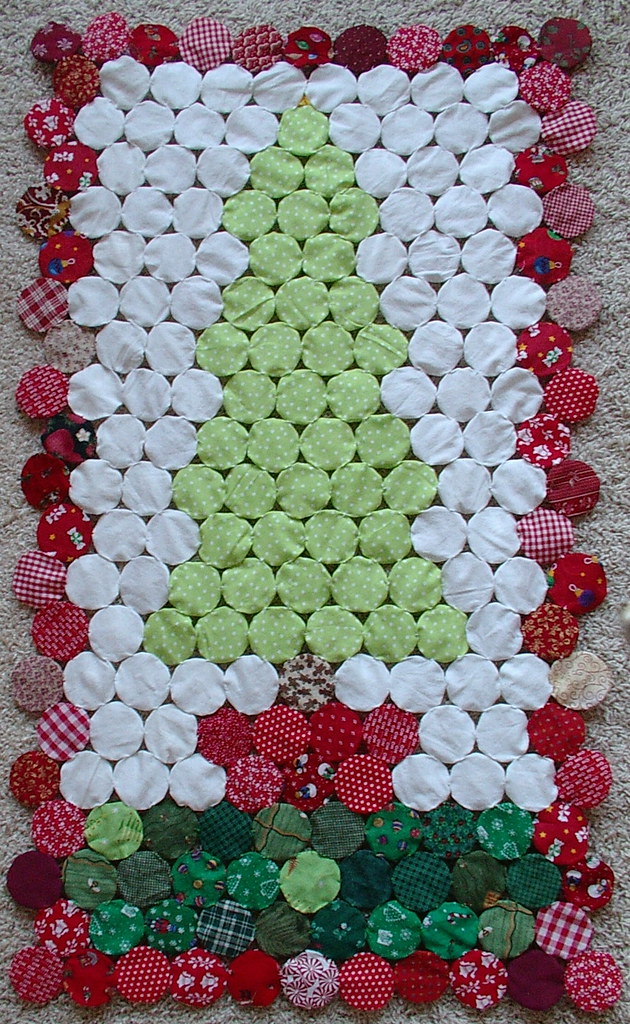 Green fabrics (you can use 1 or lots of green fabrics, I choose solid for the tree and variety for the ground) 42 green yoyos tree, 25 green yoyos ground = total 67 green yoyos
- White fabrics (you can use 1 or lots of white fabrics) ( I used recycled 100% cotton, from my husband's outgrown Sunday shirts, 2 of them) 86 white yoyos
- Red fabrics (you can use 1 or lots of red fabrics, I used lots of varieties) 67 red yoyos
- Brown fabric enough for 1 yoyo
- Yellow fabric enough for 1 yoyo for star (I used the small clover flower maker to make my star)
- Standard cd to use as template
- Thread
- Needle
- Scissors
- Thimble (if you use one)
- Pencil, optional (for tracing around cd; I don't do this, but some might)
- Optional small clover flower maker to use in making the star. You can also just buy a star at a store and sew it on instead of making one.
 2- 4 cabone rings ( or other type of ring to use as a hanger)
 Dowel or other straight item for strength when hanging
- Bias tape
- 67 buttons (I used mother-of-pearl, but you can use whatever you want)


Order of events:
- Make round yoyos and yoyo star
- Lay them out in the pattern (shown below in this post)
- Stitch together in six format, not the 4
- Add star at top of tree
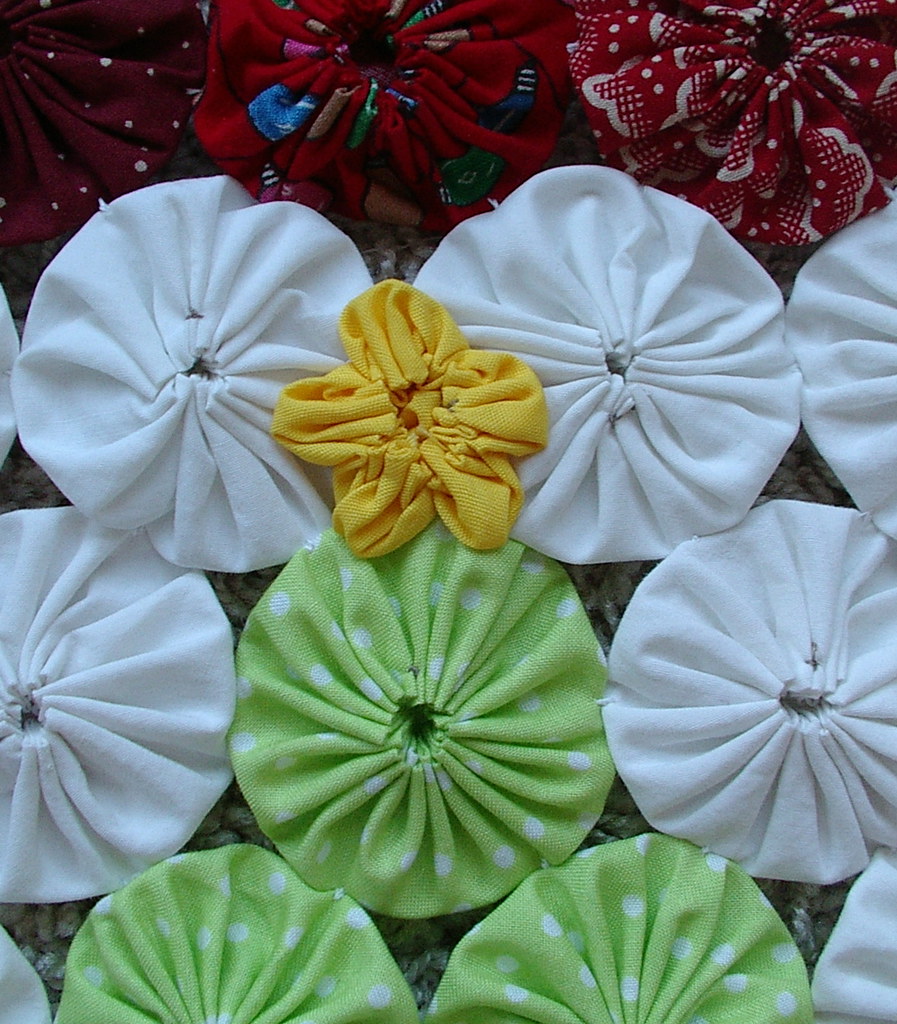
- Stitch a button on every green yoyo

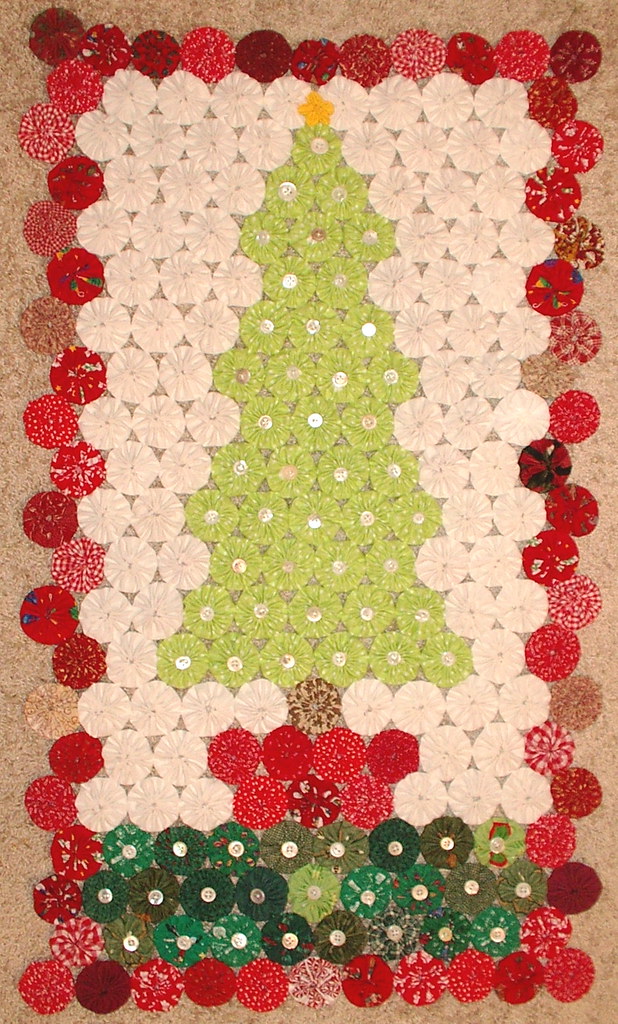
- Stitch on cabone rings (or other hanger item) on back of wall hanging on top row of yoyos; covered by bias tape
 Stitch dowel (or other straight item) to top back of quilt to help prevent sagging from weight; covered by bias tape

- 11 red
- 1 red 8 white 1 red
- 1 red 4 white 1 green 4 white 1 red
- 1 red 3 white 2 green 3 white 1 red
- 1 red 3 white 3 green 3 white 1 red
- 1 red 3 white 2 green 3 white 1 red
- 1 red 3 white 3 green 3 white 1 red
- 1 red 2 white 4 green 2 white 1 red
- 1 red 3 white 3 green 3 white 1 red
- 1 red 2 white 4 green 2 white 1 red
- 1 red 2 white 5 green 2 white 1 red
- 1 red 2 white 4 green 2 white 1 red
- 1 red 2 white 5 green 2 white 1 red
- 1 red 1 white 6 green 1 white 1 red
- 1 red 4 white 1 brown 4 white 1 red
- 1 red 2 white 4 red 2 white 1 red
- 1 red 3 white 3 red 3 white 1 red
- 1 red 8 green 1 red
- 1 red 9 green 1 red
- 1 red 8 green 1 red
- 11 red
Add front embellishments like the star and buttons now. The buttons are for holding the ornaments on the tree. They are also to hold the ornaments on the bottom ground area 'till they are moved up. There are more buttons on the tree than on the ground so you can have more of a choice where to place them.

Stitch two to four cabone rings (or other hanging devises -- I used metal belt loops because that is what I had on hand) on top row for hanging purposes. Use four if you don't use a dowel for strength and to keep quilt from sagging. Once stitched on, cover stitches with bias tape, too, just like the dowel.
Here is the link to make all the ornaments to add to this advent calendar.
DO NOT USE THIS PATTERN TO MAKE THINGS TO SELL FOR PERSONAL USE ONLY!!!!
Monday, August 27, 2007
explore photos
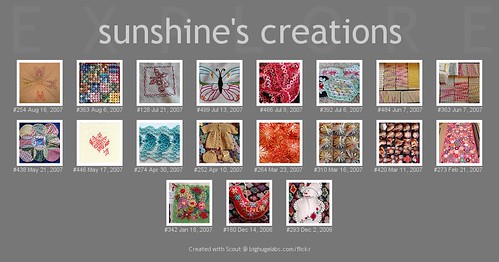
Created with fd's Flickr Toys.
Friday, July 27, 2007
Explore Photos as of July 27, 2007
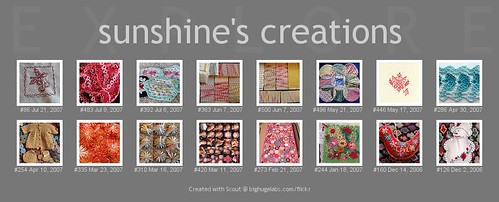
explore photos as of Jul27 2007, originally uploaded by sunshine's creations.
1. This block is made by clare, 2. lt and dk pink tatting, 3. hex granny squares, 4. antique tatting, 5. more antique tatting, 6. front, 7. redwork butterfly signature block, 8. style d,
9. layette set, 10. crazy daisies, 11. flower tutorial, 12. English Paper piecing tutorial, 13. bubble gum pink quilt #1, 14. lazy daisy week 3, 15. back side dove, 16. felt snow man done, style:christmas colors
1. This block is made by clare, 2. lt and dk pink tatting, 3. hex granny squares, 4. antique tatting, 5. more antique tatting, 6. front, 7. redwork butterfly signature block, 8. style d,
9. layette set, 10. crazy daisies, 11. flower tutorial, 12. English Paper piecing tutorial, 13. bubble gum pink quilt #1, 14. lazy daisy week 3, 15. back side dove, 16. felt snow man done, style:christmas colors
Tuesday, June 12, 2007
photos on explore
Some of these are on explore currently, and some are in the past and bounce in and out of explore. If you want to make one of these charts, go here then click on scout and log in and make a poster, as it is called.

photos on explore, originally uploaded by sunshine's creations.
1. redwork butterfly signature block, 2. style d, 3. crazy daisies, 4. flower tutorial, 5. bubble gum pink quilt #1, 6. back side dove, 7. felt snow man done, style:christmas colors
Sunday, April 01, 2007
My Tutorial is in an E-zine
 There is a E-zine (electronic magazine) that just came out called "Small Town Living". My English Paper piecing tutorial is a feature in this e-zine. You can find it on pages 25 -31. This is the second time I have been a feature in this magazine; the first was the Jan/Feb issue. I wish Tina and her husband lots of success with their baby mag; it is on its fourth edition. Please feel free to follow the links and read this magazine and their other three editions; they are at this link, too.
Saturday, March 10, 2007
Tutorial on English Paper Piecing : Grandmother's Flower Garden
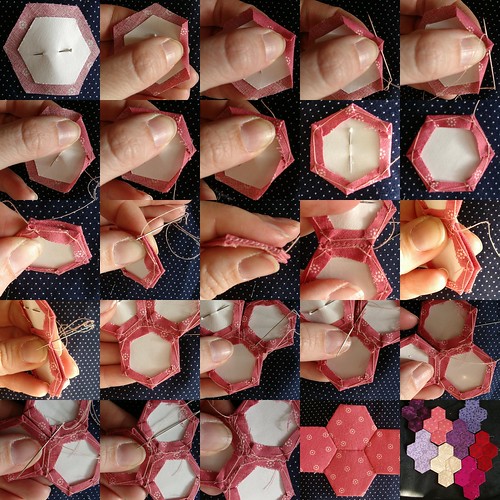
Prep work: cut paper templates and fabric
I actually like to buy my templates, mine are die cut, this gives more accuracy to my work and speeds up the process; you can do it either way, though, buy or make. Finished size paper templates are 1/4 inch shorter on each side than the unfinished size template for the piece of fabric.
My papers are 3/4 inch; this is my finished size for the hex block. My fabric pieces are 1 inch to a side. Just a side note, when I buy my pieces I buy two sizes; one for the finished size in a bulk big package and a small package to use as my templates for cutting my fabric.
Ways of cutting fabric
If I am using scraps, I use a pair of scissors to cut my fabric hexagons. If I am purposely using yardage, uncut fabric, I will use a rotary cutter. With this size hexagon I cut my strips to 1 1/2 inches wide. Then I place my template on the strips and cut the six sides. After you have cut one, each time you add the template you will only be cutting five sides because one is already cut.
To get the measurement for whatever size hexagon you are using, you will measure from point to point on the unfinished template piece of fabric. On mine that was 1 1/2 inches; yours will vary if you are using a different size hex than I am.
****** Update between stars******
There is an easier way of doing this if you do not care about your seam allowance being exactly 1/4 inch. You can just cut a square that will work to fold over all the sides of the hex. A rectangle would be better than a square for seam allowances but I have not seen people use a rectangle only a square. I do not do it this way as I am picky on my seam allowance but it is an option for you just make sure your square/rectangle is 1/2 wider and taller than your hex. This will speed up the cutting process and if you machine quilt it doesn't matter to much for the bulk. If you plan to hand quilt I do not recommend this: unless after you baste you go back and trim your seam allowances back to 1/4 inch.******end of update*****
Basting
- Pin paper to wrong side of fabric. I skip this step, but when you are starting out it is a good rule of thumb to do this 'till you get use to it.
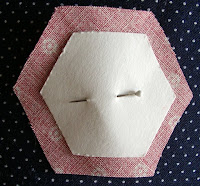 Next you fold over the right side of the fabric followed by the top side. If left handed, do the opposite (do the left followed by the top).

- At this point you can have a knot on your thread, if you so desire. I placed one on mine for the picture, but usually I do not use one; I leave a little tail hanging out. This is a little harder technique when starting, so for beginners I recommend a small knot. Place needle in fabric going right to left and slightly up. Pull needle through and repeat this step by making another stitch in the same spot, aka a back stitch. This will hold the corners in place.


- Rotate hex in left hand so the point that you just finished is pointing right.
 If left handed, rotate left and point last done will be pointing left. Fold down top like you did before.
 Insert needle from right to left, repeat. Repeat this last section of rotation and insert needle twice then repeat all the way around. If left handed, insert needle from left to right, of course.
 Finish off on sixth corner; you don't have to do the first one again. Cut thread; you don't need a knot if you leave a tail when you cut the thread.
 Exception to the rule: if your finished hex size is over 1 1/2 inches, it's good to do the first corner one more time. A lot of tutorials on this technique tell you to stitch through the paper; I don't like to do that as you have to cut all those threads when done. I only stitch through the paper if my finished hex size is bigger than 2 inches (I don't do that size often). If I am doing that size, then I do one stitch in the middle of each side. This is a really tiny stitch see example I posted at a later date than this post. This way when I want to remove the papers all I have to do is make a small snip with scissors (6 times per block) and pull the papers out. This leaves in the corner stitches and the other stitches are pulled to the back. These middle stitches are known as a stabilizing stitch, and I only do them one to a side. More than one stabilizing stitch to a side and you have to pull out threads. It also takes too much time, and I believe it to be a waste of time. Make sure if you are doing your hexagons like mine (you leave your basting stitches in), that you use a basting thread that will not show through your work when finished.
 - On the last hexagon for a flower or whatever shape you are doing, I finish my hex a little differently. At the end of basting I do the first corner again, but I bring my needle out in the point of the hex. This sets me up for the next step which is assembling the blocks. If you noticed, this block doesn't have a pin in it. Like I said, that is a step I don't do any more, but when I was learning how I did. That is a personal choice.


Assembly
- Place two hexagons right sides together. If right handed your starting thread should be on the left;
 if left handed, on the right. Insert needle grabbing only two or three thread thicknesses on each fabric of each hex.
 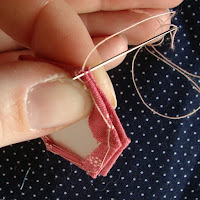 DO NOT GO THROUGH THE PAPER. This is a common mistake beginners make. This makes it hard to remove the papers later. It also makes the papers not able to be used again, and wears out your fingers, too . If you do not stitch into the paper you will have an easy time pulling the papers out at the end, and you will be able to reuse the papers dozens of times, if not more. Make your stitches small and even.
 There should not be any gaps or openings when unfolded.
 Side Notes: I use Gutterman quilting thread 100% cotton and a #9 quilters betweens needle to sew mine together. Use what you like and are comfortable with. Also I like to take one extra stitch at the corners to make them a little stronger because this is where all the pressure is when used and might break easier without this extra stitch.
 - Your thread should be at a corner from the last side you stitched. Repeat the steps in step one of assembly.


- Now a few things that come up while you are assembling your blocks together: First there is back tracking. This means your thread is in one spot but you really need it in another that isn't too far away. Instead of cutting your thread and tying a lot of knots, you can back track. It is faster and fewer knots on the back of your work. In this picture my thread is on the lower right of a seam and I need it in the upper left of the same seam.
 So to get there, I travel over the stitches I have already done. My stitches only go through the fabric on the back of the work, never through the paper and never all the way to the front of the work. They are never more than 1/4 of an inch from each other.
 They do go in the opposite direction of the other stitches (see the stitches' different slants). Now I am where I want to be at the start of the next spot to stitch, also known as a "Y" seam because it resembles the letter "Y".
- Next you have what is known as a "Y" seam. You can see the spot I have yet to stitch in the photo.
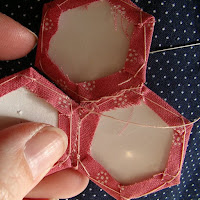 A "Y" seam is where 3 seams come together. When sewing with a machine this can be intimidating to some people. But when doing hand piecing it is easy to work with. The stitches are taken just as before, with little bits of fabric. The only difference is, this time the pieces just aren't laying face to face.

 You can make them lay face to face if it is easier for you. To do that you just crease the hex block at the end of the seam you are doing, where my needle started the seam. This is not my preference because it wears out my papers and makes them less usable, and sometimes the paper pops out, too. Continue in whichever technique you prefer until you have your flower made or what ever shape you are making, I am making diamond shapes.
  When finished stitching the block together, knot and cut thread.


 My papers are actually made out of card stock to make them last longer. Yes, you can use normal paper, but it has a lot of drawbacks, it is very flimsy and doesn't hold up well to wear and tear. When I remove the papers ,I just use a pair of tweezers on real small hexagons, 1/4 inch. If the hexagon is larger than 1 inch, then I just pull them out with my hands. Some people like to punch a hole in the middle of the paper, with a standard size hole punch, before basting it. Then to pull out the papers they put a crochet hook in the hole and pop them out that way. I do not do this because it weakens the papers. Once again, a personal preference; do what you like best, even try both.
The papers DO NOT get left in the quilt. Years ago they, pioneers, did leave the paper in when they used the old "Sears and Robuck "catalog pages as their paper templates, and they tied those quilts. They did not quilt that type, it was too hard going through the papers. Leaving the papers in added extra warmth; it also made the quilts rustle. So, if you have a real old quilt that rustles like paper a little when moved around, that is what is probably inside of it. I remove the papers as I go along, sewing the blocks together. If a single hex has all 6 hexagons bordering it sewn to it, I remove its papers, the center hex, that is.
******Update*****
For those who have asked I found a tutorial (http://thatgirlthatquilt.blogspot.com/2010/08/binding-hexagons-tutorial.html) on line on binding thought you might like it if you have finished your top and don't know what to do. This is not how I bind mine but it is a good way all the same. I bind by hand.******End of Update*****
This tutorial was featured in Small Town Living Magazine in Apr/May 2007 issue.
If you have any questions let me know in comments and I will also answer them in the comments area to help everyone else who reads this because they may have the same question. Also click on photos for a bigger image if you can't see what I am talking about. If you would like to see items I have made, or am currently making, with this technique click here.
If you do decide to try this technique, there is a group on flickr that you are welcome to join and post your results there. This is a group about people who like to do hand piece using English paper piecing method or any other type of foundation piecing. Yes machine foundation piecing is welcome in the group, too.
DO NOT USE THIS PATTERN TO MAKE THINGS TO SELL FOR PERSONAL USE ONLY!!!!
Subscribe to:
Posts (Atom)
Copyright/permissions info
I like to share on this space my ideas and projects.
Please don't take ideas or photo and claim them as your work.
I am always happy to have new links to me. So if you like something just link back to me and give the source some credit thanks.
Any questions? just ask. I am happy to work with you if you need something
 This work is licensed under a Creative Commons Attribution-Noncommercial-No Derivative Works 3.0 Unported License.
2006-2019
Copyright Vintage Threads Inc.
All content and images.
This work is licensed under a Creative Commons Attribution-Noncommercial-No Derivative Works 3.0 Unported License.
2006-2019
Copyright Vintage Threads Inc.
All content and images.
LinkWithin
